Place a brooch where its weight and shape work with the garment
A brooch adds a focal point and a physical load. Choose its location by considering fabric support, closures and the way the garment moves. A small placement exercise can reveal more than buying another accessory, while protecting pieces that may not tolerate pinning or weight.
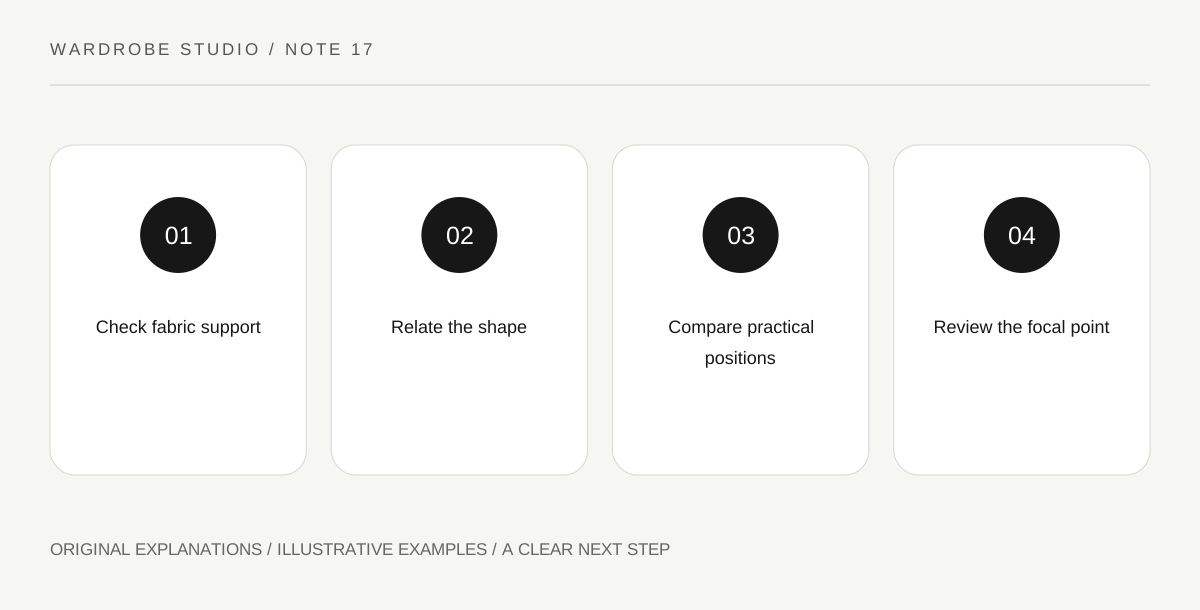
Original explanatory diagram. Read the full method and limitations below.
Inspect the brooch and the fabric
Check the fastening, point and weight before placing it. A substantial piece can pull on a fine knit or fluid cloth. Delicate or valuable garments may not be suitable for pinning at all. Do not assume that a temporary placement leaves no mark.
Use a sturdy compatible garment for a first experiment and follow any item-specific guidance. If you are unsure about damage, choose another accessory or obtain appropriate advice. The visual idea should not require risking a fabric simply because a similar arrangement appeared in an editorial image.
Choose what the shape should relate to
A geometric brooch can echo a collar edge or introduce a contrast to a curved neckline. A floral form can relate to a print, but it does not need to repeat every motif. Look at the actual shape, size and surface rather than classify brooches as belonging to one age or style.
Place the brooch near a seam or lapel only if that area supports it appropriately. Then stand back and notice where attention goes. A piece that looks small in the hand may become prominent when isolated on plain cloth. Its visual importance depends on context as well as dimensions.
Try positions before making a final attachment
Hold the brooch near two possible locations without dragging the pin across the fabric. Compare a higher and lower placement, or one close to an edge and one farther in. Choose positions that remain practical when seated and carrying a bag.
A strap may hit or cover the brooch; a coat may catch it. Include those layers in the decision. The accessory should not obstruct a closure or make normal movement uncomfortable. A preferred placement on an unlayered top may need to change when an outer garment is added.
Keep surrounding details proportionate
A statement brooch may work best as the main detail, while a quieter one can coexist with earrings or a necklace. There is no fixed number of accessories that guarantees restraint. Notice whether the details support the same effect or compete in a way you do not enjoy.
For an exercise, compare the brooch alone with the same outfit plus one other accessory. Record what changes in emphasis. Remove the brooch before cleaning or storing as appropriate to the items, and check that the fastening remains secure during ordinary wear without claiming that a brief trial proves long-term reliability.
Illustrative lapel placement
A wearer has a small geometric brooch and a firm jacket lapel. Near the top edge it is partly hidden by a shoulder bag strap; lower down it remains visible and supported. They omit a necklace because the brooch already supplies the desired focal point. They avoid moving it to a fine blouse that may not support the pin and weight.
Practical checks
Optional checkboxes save only in this browser.
Questions that come up
Can a brooch go on any fabric?
No. Weight, pinning and fabric structure can create damage or distortion. Use item-specific guidance and avoid experimenting on delicate or valuable material when uncertain.
Is there one correct side for a brooch?
There is no universal everyday styling rule that overrides the garment and your preference. Consider support, visibility and interference. Specific uniforms or ceremonial settings may have their own requirements.
References and scope
These sources support the factual background. Examples and exercises are original illustrative teaching material. References do not imply endorsement.
- Getty Museum: Principles of design — Vocabulary for visual weight, emphasis, repetition, balance and proportion used in original outfit exercises.
- Getty Museum: Elements of art — Distinguishing line, shape, color value, intensity, space and texture.
- V&A: Art Deco fashion — Historical examples of geometry, fluid fabric, surface sheen and decorative detail.
- ACCC: Care labelling on clothing and textiles — Following care instructions for the finished garment rather than assuming treatment from appearance.