Use visible socks as a chosen colour or pattern detail
Visible socks create a small area of colour and texture between clothing and shoes. Treat that area as part of the outfit rather than an accidental gap. Check fit inside the actual footwear first, then decide whether the socks should repeat a detail, create contrast or remain visually quiet.
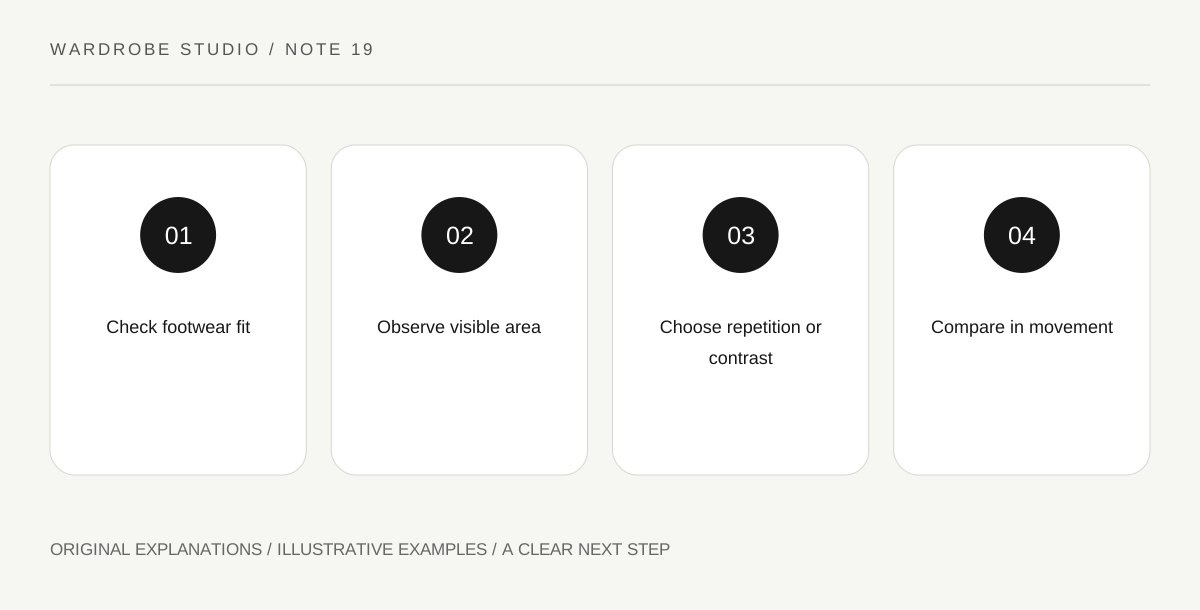
Original explanatory diagram. Read the full method and limitations below.
Start with footwear compatibility
Sock thickness changes how a shoe feels. Try the intended pair inside the actual footwear and walk normally. Check for crowding, slipping or rubbing rather than assume a decorative sock is interchangeable with the pair you usually wear.
A style experiment should not require tolerating discomfort. If the sock changes fit unfavorably, choose another thickness or another combination. This is a practical wearing check, not medical advice or a guarantee that a brief indoor trial establishes suitability for a long day.
A repeated motif can be tiny and still visible through contrast, so compare the actual pattern rather than rely only on its dimensions.
Look at the visible area
The amount of sock shown changes while sitting and walking. A trouser hem may reveal only a small strip when standing and much more when seated. Observe both views before deciding whether the pattern is too strong or too quiet for your preference.
A narrow visible band can make a bright colour feel like a small accent. A larger area may become a main detail. The same sock can therefore play different roles with different garments, without needing a rule that one length always suits one kind of wearer.
Choose repetition or surprise
A sock can echo a colour in a top or bag, repeat a small motif or introduce a new contrasting note. Start with one connection and see whether you enjoy it. Matching every accessory can create a deliberate theme, but it is not necessary for coherence.
If the sock carries a busy pattern, consider what remains visible above and below. A detailed shoe and a patterned trouser can create a dense small zone. You may enjoy that energy or prefer one quieter element. Describe the effect rather than call it wrong by default.
Account for texture and movement
Ribs, fine knit and sheen change the appearance even within one colour. A sock that collapses into folds may create a different visible shape from one that stays upright. Choose the effect you want while ensuring the cuff remains comfortable and the material suits your needs.
For an exercise, compare a quiet solid pair with a patterned pair in the same practical footwear. Sit, walk and look from normal distance. Note whether the preference concerns colour, visible area or fit. Keep those reasons separate so you can reuse the observation in another outfit.
Illustrative small accent
A wearer has plain cropped trousers, dark shoes and a green patterned top. Thin green socks repeat one colour, while dotted socks introduce another motif. Both fit the shoes comfortably. When seated, the dots become more prominent than expected. The wearer chooses the solid pair for a quieter outfit and keeps the dots for a day when that playful detail is welcome.
Practical checks
Optional checkboxes save only in this browser.
Questions that come up
Must socks match shoes or trousers?
No. Matching can make the area quiet, while contrast can make it a feature. Choose the effect you want and check it in the actual outfit rather than follow a universal colour rule.
Can a decorative sock replace any everyday pair?
Not necessarily. Thickness, grip, cuff and material can change comfort and shoe fit. Try the real combination and choose function before relying on appearance.
References and scope
These sources support the factual background. Examples and exercises are original illustrative teaching material. References do not imply endorsement.
- Getty Museum: Principles of design — Vocabulary for visual weight, emphasis, repetition, balance and proportion used in original outfit exercises.
- Getty Museum: Elements of art — Distinguishing line, shape, color value, intensity, space and texture.
- V&A: Textiles collection — Distinguishing printed, woven, embroidered and other textile surfaces.