Let your existing glasses guide an outfit’s small details
Glasses can be a consistent visible feature of an outfit. Work with the frames you already use by noticing their shape, colour and visual weight, then decide how other details relate. This is a styling exercise, separate from choosing lenses, assessing vision or adjusting optical fit.
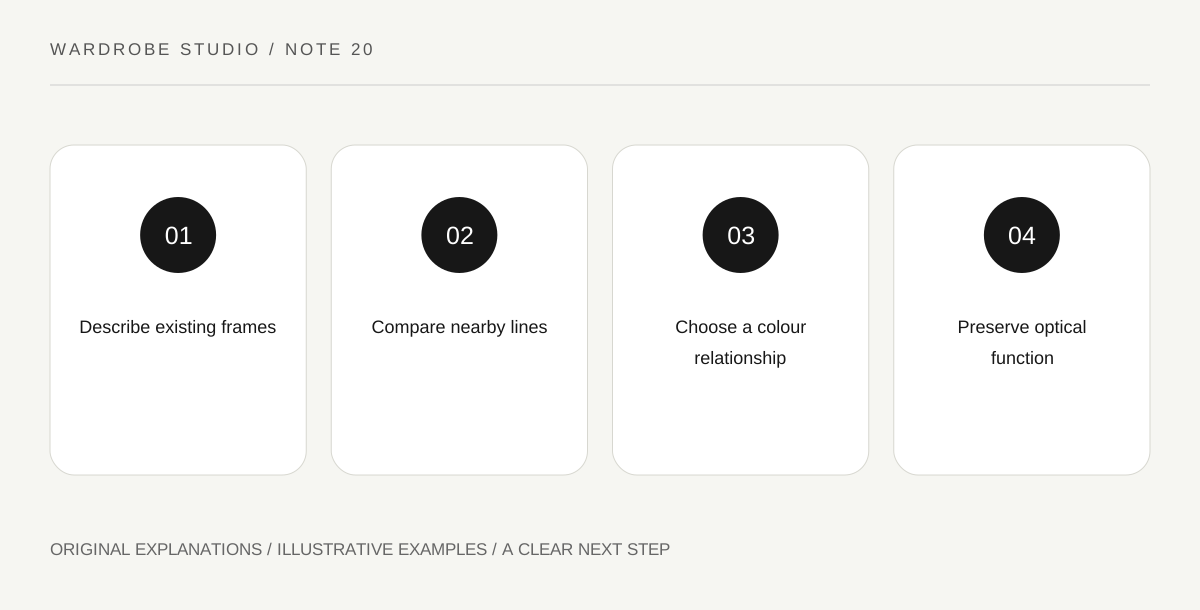
Original explanatory diagram. Read the full method and limitations below.
Describe the frames without face-shape rules
Notice whether the frame has rounded or angular lines, a light or dark value and a thin or substantial outline. Look at the glasses as an object rather than assign them to a supposedly correct face category. Personal preference and optical requirements are different considerations.
You may wear the same frames daily, so they can provide continuity across varied outfits. That does not mean every garment must match them. A stable detail can support either repetition or contrast, and you can choose how much attention you want to direct toward it.
Compare nearby details first
Earrings, collars and necklaces sit near the frames and can create a concentrated cluster of lines. Try one accessory at a time. A curved earring may echo rounded frames; an angular one may introduce a deliberate contrast. Neither is universally required.
Observe the full area from a normal conversational distance. Tiny details that seem important while leaning toward a mirror may be barely visible to another person. Avoid buying accessories to solve a problem that exists only in an extreme close-up or an unfamiliar camera angle.
Use colour as one possible connection
A garment can echo a frame colour, or a quiet neckline can let the frames remain the main dark shape. Transparent, metallic and patterned frames still contribute visual information, even when described as neutral. Look at the actual appearance rather than assume the label makes them invisible.
If you enjoy a bold top, the frames do not have to disappear. Decide whether the combination feels lively or crowded to you. The goal is a chosen relationship among visible details, not a rule that a person may have only one expressive feature.
Keep optical function outside the styling experiment
Do not bend frames, change lens use or compromise needed vision to complete an outfit. Questions about comfort, prescription and fit belong with an appropriate optical professional. This exercise concerns the surrounding clothing and accessories, which can change without altering the glasses themselves.
For a practical comparison, use the same frames with two neckline and earring arrangements you already own. Record what changes in emphasis and what remains comfortable. You may prefer different versions for video calls, in-person meetings or relaxed days, without treating one as a correction of your face.
Illustrative frame relationship
A wearer has substantial dark rectangular frames. A sharply pointed collar and geometric earrings create more angular detail than they want for a quiet outfit. They replace the earrings with a small curved pair and choose an open plain neckline. The glasses remain the same; only nearby details change. Optical function and fit are left to the wearer’s established professional guidance.
Practical checks
Optional checkboxes save only in this browser.
Questions that come up
Must frame shape follow a face-shape formula?
This exercise does not require one. Work with your existing functional frames and personal preference. Optical fit and vision needs require appropriate professional input, while surrounding outfit details remain optional design choices.
Should bold glasses mean no jewelry?
No. You can combine expressive details or choose a quieter arrangement. Compare their actual size, shape and distance from one another rather than apply a blanket ban.
References and scope
These sources support the factual background. Examples and exercises are original illustrative teaching material. References do not imply endorsement.
- Getty Museum: Principles of design — Vocabulary for visual weight, emphasis, repetition, balance and proportion used in original outfit exercises.
- Getty Museum: Elements of art — Distinguishing line, shape, color value, intensity, space and texture.
- V&A: Art Deco fashion — Historical examples of geometry, fluid fabric, surface sheen and decorative detail.