Work with cargo-trouser pockets instead of ignoring them
Cargo trousers add three-dimensional pockets as well as a relaxed outline. Their position and fullness affect the outfit, especially when the pockets are used. Choose the rest of the combination around the actual garment and the day’s tasks rather than assuming every utility style must look rugged.
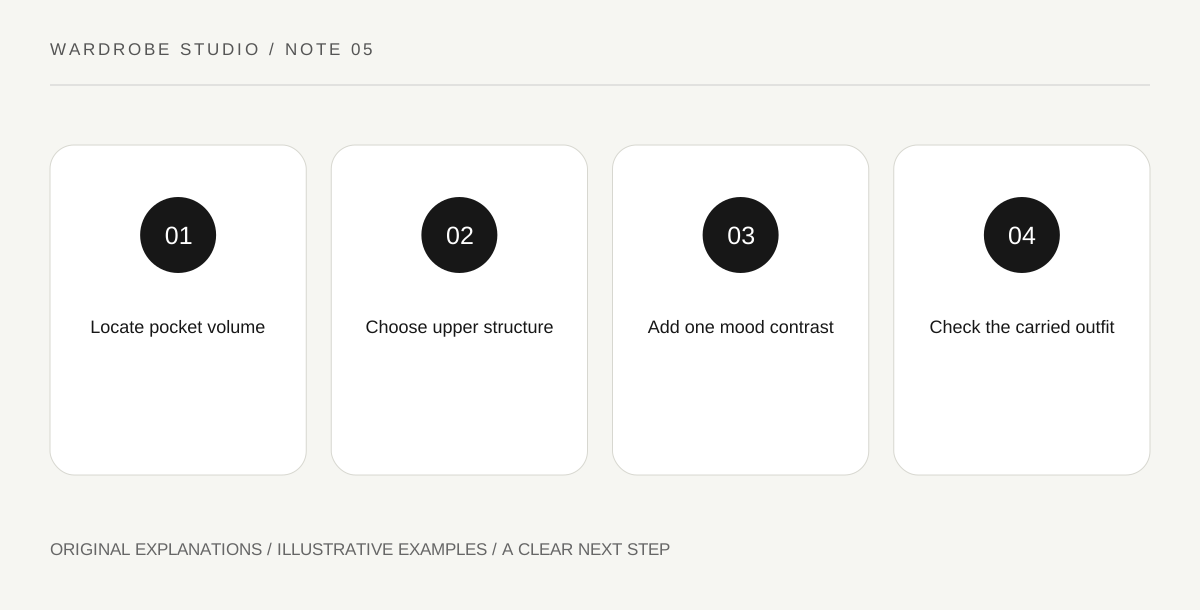
Original explanatory diagram. Read the full method and limitations below.
Inspect where the volume sits
Compare flat pockets with expanding bellows pockets. A large empty pocket may sit quietly until filled, while a flap can remain a visible shape even without contents. Notice side, front and rear placement rather than treating all cargo trousers as the same silhouette.
Stand and sit with the pockets empty, then add only the items you genuinely expect to carry. Check whether the fabric pulls or the contents press uncomfortably. A pocket is not useful merely because it exists; its access and behavior matter for the actual wearer.
Check whether a pocket flap stays clear of a seated surface or bag strap; a useful empty pocket can still interfere through its construction.
Choose the degree of structure above
A soft top continues the relaxed character; a crisp short-sleeved shirt introduces a different edge. Either can work if the lengths and volume feel comfortable. Choose which relationship you want rather than assume utility trousers require a fitted or masculine-looking companion.
Look at the junction where the top meets the upper pockets. A hem that repeatedly catches under a flap may need a different length or fabric. The issue is an interaction between garments, not a general judgment that the top or trousers are wrong.
Use one deliberate change of mood
A simple pendant, a smooth bag or a clearly shaped shoe can shift the outfit without disguising the trousers. You do not need to add every possible refined detail. One contrast may be enough to make utility construction feel part of your personal style.
Consider the trousers’ existing hardware: tabs, drawcords, zips and snaps. They already contribute lines and small focal points. Additional straps or dangling details can create visual and practical interference. Keep what serves the outfit and the day rather than equate more hardware with more intention.
Test the pockets during ordinary movement
Walk, sit and reach for an item using the hand you normally use. Check that closures work without excessive effort and that contents stay secure for your activity. This is a personal wearing check, not a durability test or a guarantee about any product.
Create an illustrative outfit with empty pockets for a social day and another with the actual carried items for an errand. Note whether the outline changes enough to alter your preferred top or bag. A pocket-centered garment should be assessed in use, not only arranged for a photograph.
Illustrative utility outfit
A wearer has olive cargo trousers with large side flaps. They add a soft ivory top and a small structured bag. After placing a phone in the side pocket, the trouser leg pulls while seated. They move the phone to the bag and keep the pocket mostly empty. The styling choice and practical carrying plan now work together.
Practical checks
Optional checkboxes save only in this browser.
Questions that come up
Must cargo trousers be paired with a tight top?
No. Different volumes create different outlines. Try the particular garments and decide what you enjoy, while checking pocket access and movement. There is no requirement to balance every relaxed item with a tight one.
Should I fill every pocket to use the design properly?
No. Use only the pockets that are comfortable and appropriate for the items. Their visual presence can be part of the style even when they remain empty.
References and scope
These sources support the factual background. Examples and exercises are original illustrative teaching material. References do not imply endorsement.
- Getty Museum: Principles of design — Vocabulary for visual weight, emphasis, repetition, balance and proportion used in original outfit exercises.
- Getty Museum: Elements of art — Distinguishing line, shape, color value, intensity, space and texture.
- V&A: Secrets of Balenciaga’s construction — Examples showing that pattern cutting, fabric and construction determine garment form; not a prescription for modern outfits.