Choose whether a tailored waistcoat works alone or over a layer
A tailored waistcoat can function as a top or as a layer, but the same garment may not fit both jobs comfortably. Check armholes, closure tension and coverage before styling around it. Then choose the visible inner area and trouser or skirt relationship that suits the design.
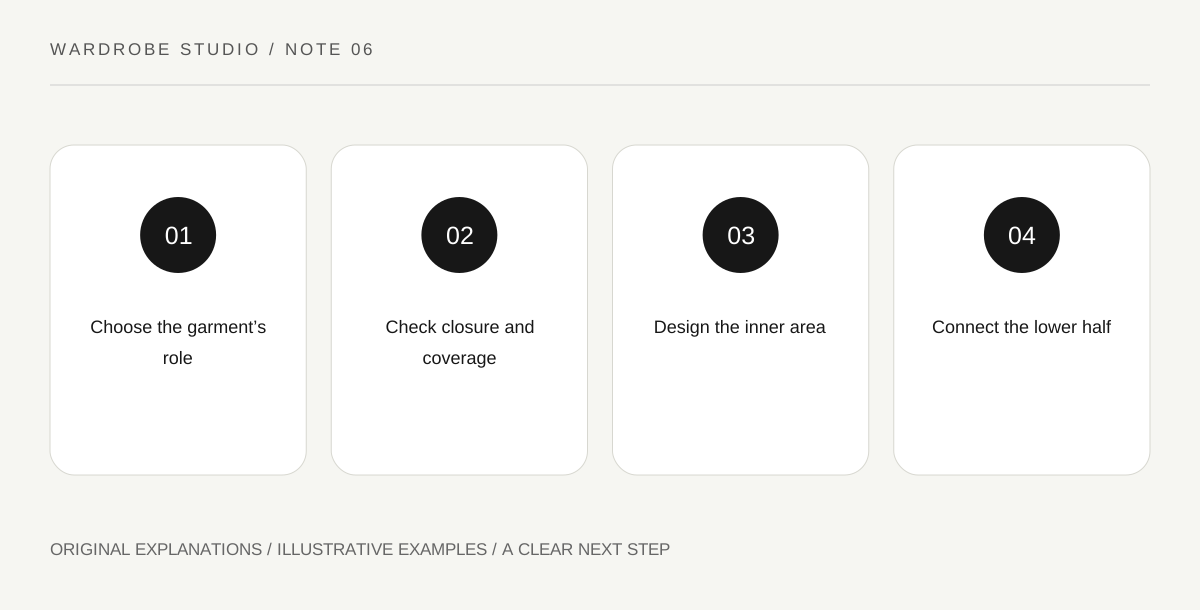
Original explanatory diagram. Read the full method and limitations below.
Identify the garment’s intended role
Some waistcoats are designed as outer layers with generous armholes; others are cut to be worn as tops. Inspect the garment itself rather than assume a product category guarantees coverage or comfort. A lining, low side opening or narrow front overlap can affect how it wears.
Try it over your intended underlayer and, if appropriate, on its own with the undergarments you choose. Move naturally and look from the side as well as the front. You are checking whether the construction suits your preference, not whether you can hold a pose that hides an unwanted gap.
Assess closure without forcing the shape
Fasten the buttons as designed and notice whether fabric pulls between them. Tension can distort the front edge and reduce seated comfort. Leaving a button open changes the appearance, but it is not always a solution to an unsuitable fit or a closure that cannot function normally.
Sit and reach forward. The waistcoat should allow the movements you need for the day. If it works standing but becomes uncomfortable at a table, choose another combination or obtain appropriate fit advice. Accessories cannot correct the physical relationship between the garment and your movement.
Design the visible inner area
Over a shirt, the waistcoat frames the collar, sleeves and front panel. A busy shirt may become a deliberate focal point; a plain one keeps attention on tailoring. Compare the opening’s shape with the shirt’s details before adding a necklace or brooch.
Worn as a top, the neckline and armholes become more prominent. Choose jewelry only after deciding what coverage and comfort you want. You do not have to fill every open area. Empty space is part of a composition and can let the garment’s edge remain clear.
Connect the lower half without requiring a suit
Matching trousers can create a coordinated set, while a skirt or differently textured trouser creates separation. Look at where the waistcoat’s points end and whether they overlap the waistband comfortably. The exact lengths matter more than a universal claim about the ideal waist.
For a comparison, create one layered outfit and one top-only outfit if the garment supports both. Record what changes in function, not just appearance: temperature, movement, coverage and access to pockets. Keep only the versions you would willingly wear through the actual day.
Illustrative waistcoat decision
A wearer likes a linen-blend waistcoat over a thin shirt. Alone, its armholes reveal more than they want, so they keep it as a layer. They pair it with a plain skirt and let the shirt collar remain the main detail. The decision uses the garment’s real cut instead of assuming that every waistcoat should serve as a sleeveless top.
Practical checks
Optional checkboxes save only in this browser.
Questions that come up
Can every waistcoat be worn as a top?
No. Armholes, overlap, lining and construction vary. Try the specific garment with your desired coverage and movement. A category label or photograph cannot establish whether it works for you.
Do I need matching trousers?
No. A matching set is one direction, while contrasting texture or a skirt offers another. Compare the actual edge, length and comfort rather than require the waistcoat to imitate a complete suit.
References and scope
These sources support the factual background. Examples and exercises are original illustrative teaching material. References do not imply endorsement.
- Getty Museum: Principles of design — Vocabulary for visual weight, emphasis, repetition, balance and proportion used in original outfit exercises.
- Getty Museum: Elements of art — Distinguishing line, shape, color value, intensity, space and texture.
- V&A: Secrets of Balenciaga’s construction — Examples showing that pattern cutting, fabric and construction determine garment form; not a prescription for modern outfits.
- V&A: Fashion collection — Fashion as a varied design discipline with multiple silhouettes and approaches.