Let a checked blazer’s lines guide the rest of an outfit
A checked blazer contains several design decisions already: crossing lines, background colour, tailoring and buttons. Identify which feature you want to emphasize before adding another focal point. The goal is to make the blazer useful in your own wardrobe, with comfortable movement and a level of formality suited to the setting.
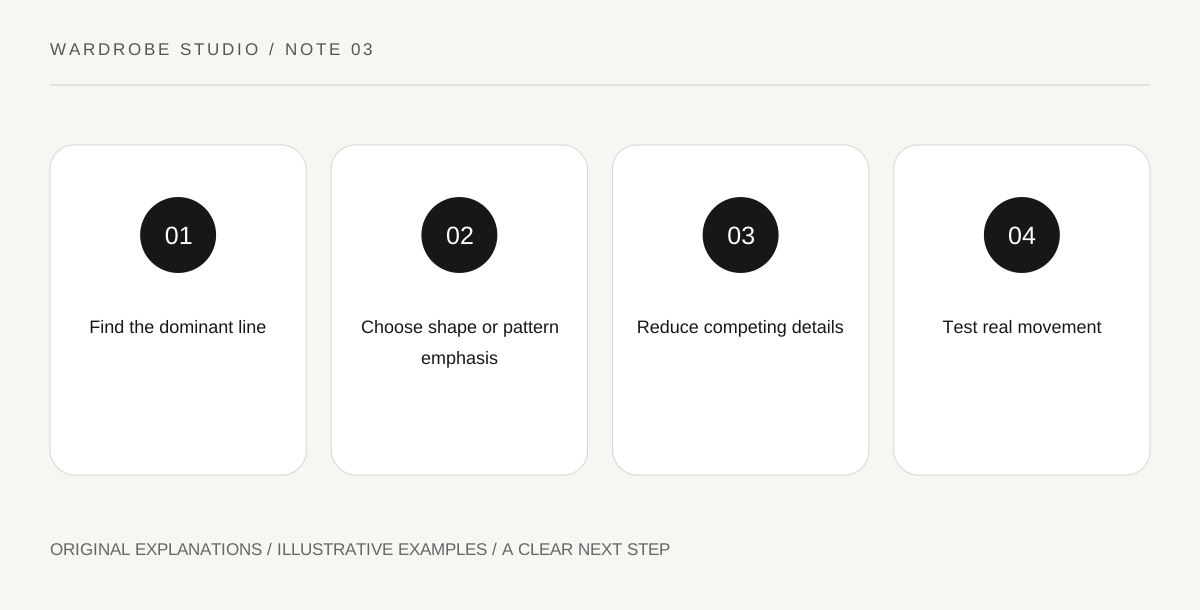
Original explanatory diagram. Read the full method and limitations below.
Find the strongest line in the check
Some checks have a dominant dark grid; others include a fine coloured overcheck. Stand back and notice what remains visible. The line that appears strongest from a normal distance may differ from the one you notice while inspecting the cloth close up.
Choose a companion colour from the overall impression rather than chase every fine thread. A tiny rust line can inspire an accent, but it does not oblige you to add rust shoes, bag and jewelry. One small reference may be enough to make the connection visible.
If the check contains several fine colours, choose the one that remains visible in ordinary light rather than require every thread to reappear elsewhere.
Decide whether the tailoring or pattern should lead
A strongly shaped shoulder can be the main feature even when the fabric is checked. In a soft unstructured jacket, the grid may attract more attention. Observe the actual garment rather than assume blazer always means one fixed outline.
Try it open and fastened if both are comfortable and intended by the design. The visible inner area changes the balance of pattern and plain fabric. Do not force a button closed to achieve a picture; tension at the closure is a fit issue, not an aesthetic challenge to solve with accessories.
Choose a companion with a different kind of detail
A plain textured top can create interest without introducing another grid. A quiet trouser or skirt lets the blazer’s crossing lines remain legible. If you add a second pattern, compare its scale and direction rather than assume any two checks will behave alike.
Look at buttons, pocket flaps and bag hardware as part of the composition. A blazer already carrying several contrasting details may not need a decorative necklace. Removing one item can reveal the effect you wanted without making the outfit feel unfinished.
Give the jacket a real activity test
Sit, reach and carry the bag you expect to use. Sleeves and armholes should allow your ordinary movement. The purpose is to decide whether this particular blazer works for this day, not to measure your body against a standard image of tailoring.
For an exercise, build a quiet version with a plain inner layer and a more graphic version using one colour accent from the check. Compare the entire outfit under normal light. Record which feature leads in each, then choose based on your setting and preference.
Illustrative overcheck choice
A grey blazer has a fine green overcheck and dark buttons. Its owner tries a plain cream top with dark trousers, then replaces the top with a muted green one. The second version makes the fine line more noticeable without repeating green everywhere. They keep the dark bag simple and check that the jacket remains comfortable while seated.
Practical checks
Optional checkboxes save only in this browser.
Questions that come up
Must I wear a plain shirt under checks?
No. A plain layer is a useful way to understand the jacket first. You can add another pattern deliberately by considering scale and contrast, but it is an option rather than a ban.
Does a checked blazer automatically make an outfit formal?
No. Construction, fabric, condition, companion pieces and the actual setting all matter. Follow explicit dress requirements rather than assume the category name settles formality.
References and scope
These sources support the factual background. Examples and exercises are original illustrative teaching material. References do not imply endorsement.
- Getty Museum: Principles of design — Vocabulary for visual weight, emphasis, repetition, balance and proportion used in original outfit exercises.
- Getty Museum: Elements of art — Distinguishing line, shape, color value, intensity, space and texture.
- V&A: Secrets of Balenciaga’s construction — Examples showing that pattern cutting, fabric and construction determine garment form; not a prescription for modern outfits.
- V&A: Fashion collection — Fashion as a varied design discipline with multiple silhouettes and approaches.