Combine stripes and florals by deciding which print leads
Stripes and florals can share an outfit without becoming identical. Begin by choosing the print you want to notice first, then use scale, spacing and colour to organize the relationship. The exercise is about personal preference, not a rule that certain bodies should avoid particular patterns.
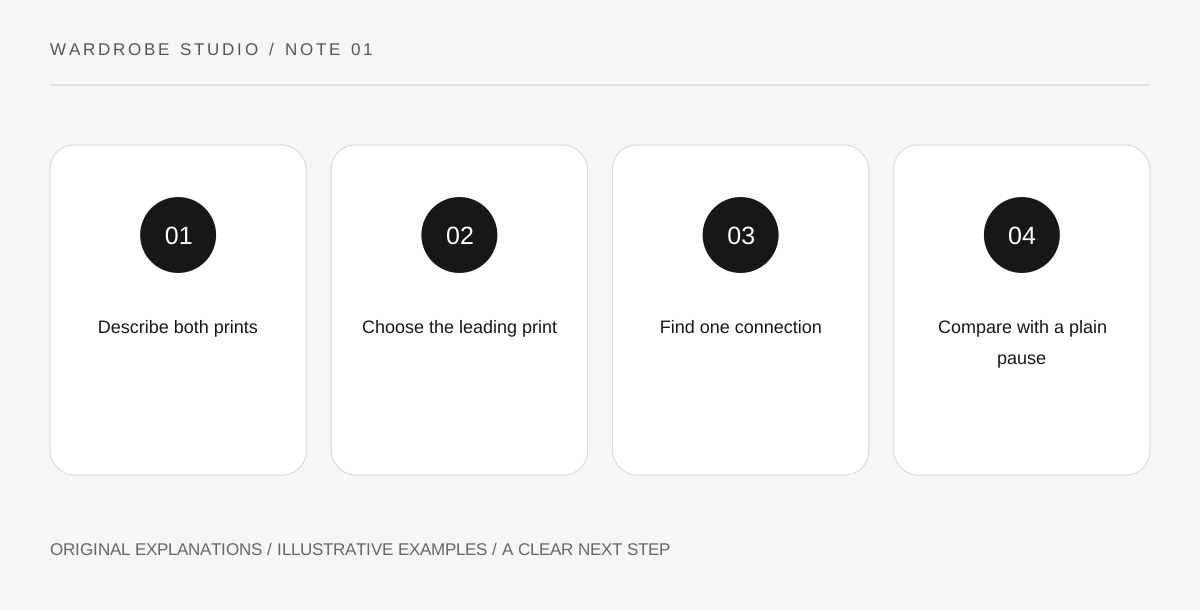
Original explanatory diagram. Read the full method and limitations below.
Identify the visual activity in each print
Lay the two garments beside each other and look at the actual marks. A floral with small scattered blossoms behaves differently from large dense petals. Stripes vary in width, spacing and contrast. Their names do not tell you how busy the combination will appear.
Describe each print with ordinary observations: wide pale stripes, small dark flowers, much empty background. This gives you something specific to adjust. Saying the prints clash may describe your reaction, but it does not identify whether colour, scale or density produced that reaction.
Choose the main print
Decide whether the floral skirt or striped top should carry most of the attention. A larger area, stronger contrast or brighter colour can make a print more prominent. You do not need to reduce every other part to invisibility; you are simply giving the combination a clear emphasis.
Try the garments at their worn positions rather than only folded on a bed. A jacket opening may reveal just a small strip of the top, changing its role. The same pair can feel different depending on how much of each print remains visible.
Create one connection without matching everything
A repeated colour can provide a link: a blue stripe may echo a blue flower or the floral’s background. The shades need not be identical. Look at them together in ordinary light and decide whether the difference feels intentional to you.
Another connection can be rhythm rather than colour. Narrow regular stripes may contrast with an open floral while sharing a restrained two-colour palette. Avoid changing shoes, bag and jewelry before you understand the relationship between the prints themselves. Too many simultaneous changes make your own preference harder to identify.
Use a plain area to separate competing marks
A plain outer layer or uninterrupted shoe can give the eye a pause when the patterns feel dense. This is an option, not a requirement for every mixed-print outfit. A deliberately energetic combination can be equally valid if you enjoy it.
For an exercise, make two versions using the same striped and floral garments: one with a plain layer and one without. Photograph only if useful and compare at a normal viewing distance. Keep the version that feels wearable in your intended setting, then note the specific reason rather than declaring a universal print rule.
Illustrative print pairing
A navy-and-cream striped top is paired with a cream skirt carrying large blue flowers. The skirt leads because its shapes cover a larger area. A plain navy jacket reduces the visible stripe area, making the relationship quieter. The wearer prefers the unjacketed version for a casual outing and the jacketed version for a more restrained mood; neither is treated as objectively correct.
Practical checks
Optional checkboxes save only in this browser.
Questions that come up
Must mixed prints share exactly the same colour?
No. A shared colour is one possible connection, but differences in scale, density or rhythm can also organize the outfit. Look at the actual garments instead of requiring an exact colour match.
Do stripes have to run in a particular direction?
No direction is universally required. Observe the line’s effect in this outfit and choose what you enjoy. Avoid treating stripe orientation as a guaranteed way to change a body’s appearance.
References and scope
These sources support the factual background. Examples and exercises are original illustrative teaching material. References do not imply endorsement.
- Getty Museum: Principles of design — Vocabulary for visual weight, emphasis, repetition, balance and proportion used in original outfit exercises.
- Getty Museum: Elements of art — Distinguishing line, shape, color value, intensity, space and texture.
- V&A: Textiles collection — Distinguishing printed, woven, embroidered and other textile surfaces.