Pair a cropped jacket with an A-line skirt by comparing actual edges
A short jacket and an expanding skirt can create a clear two-part outline, but their relationship depends on the exact lengths and fabrics. Look at where the jacket ends and the skirt begins to widen. Use those observations to choose a combination rather than rely on a fixed proportion formula.
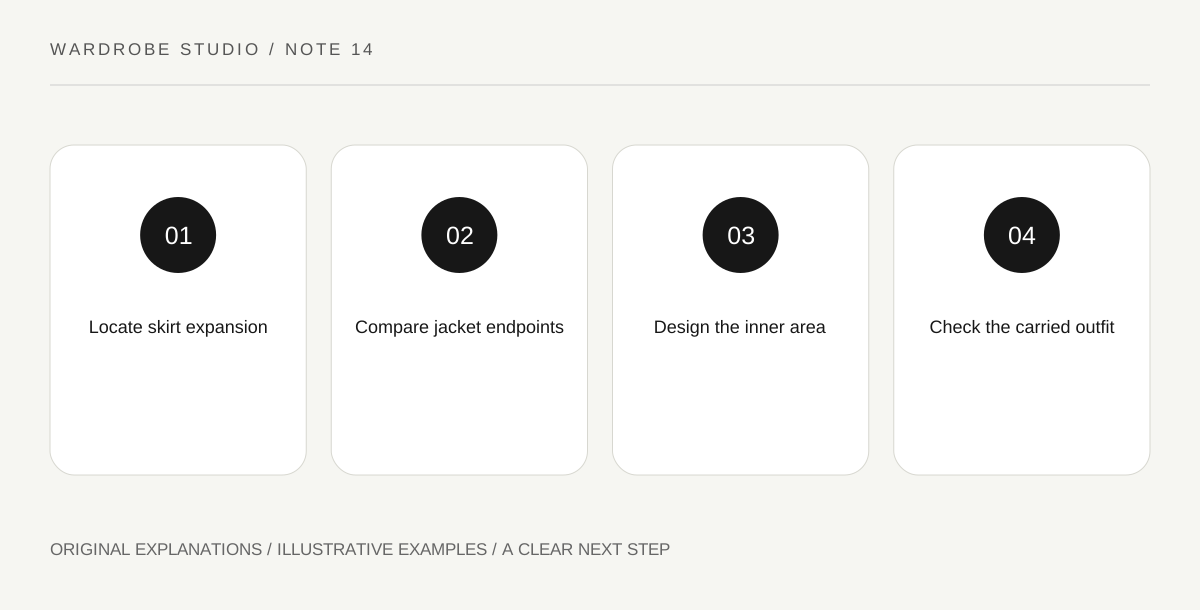
Original explanatory diagram. Read the full method and limitations below.
Find the skirt’s point of expansion
Some A-line skirts begin widening near the waistband; others remain close through the upper section before opening. A jacket can reveal or cover that transition. Put the garments on together and identify what is actually visible instead of assuming all A-line shapes behave alike.
A skirt with stiff fabric may hold a clear outward line, while a fluid one may fall closer until moving. Observe a short walk as well as a still view. The garment’s construction and material create the outline; your body is not a problem the geometry must correct.
Compare jacket endpoints
Try the intended jacket and, if available, another with a slightly different length. Notice whether the lower edge sits above, at or below the skirt’s waistband. A small gap, overlap or continuous area can each be deliberate. Choose the relation you enjoy rather than declare one universally flattering.
Check whether the jacket edge catches on a waistband or pocket. If it repeatedly flips or rides up, identify the physical contact point. A visually appealing endpoint still needs to function when seated and reaching. Another length or fabric can solve the interaction more effectively than constant adjustment.
Choose the inner area as part of the composition
An open jacket reveals a column of the base top; a fastened jacket presents more of its own shape. Decide which arrangement you actually intend to wear. The outfit should work in that state rather than rely on holding the front open for a photograph.
A contrasting inner top can emphasize the opening, while a similar value can make the jacket read more continuously. Look at the actual colours in ordinary light. You do not need to fill the neckline with jewelry if the jacket edge already provides the detail you want.
Check the complete outline in ordinary activity
Sit and move with any bag you will carry. A long shoulder strap may cross and compress the jacket differently from a handheld bag. These interactions can change both comfort and appearance, so include them before deciding the outfit is complete.
For an exercise, compare open and fastened versions while keeping the same skirt and base layer. Describe the change in visible shape, movement and temperature. The preferred result can differ by setting; the purpose is to learn this combination’s options rather than create a rule for every cropped jacket.
Illustrative edge comparison
A wearer pairs a short navy jacket with a full rust skirt. Fastened, the jacket’s edge catches on the skirt waistband. Open, it moves freely and reveals a quiet navy top. They prefer the open version and choose a bag strap that does not pull the jacket front closed. The adjustment concerns the actual garment interaction rather than an ideal body proportion.
Practical checks
Optional checkboxes save only in this browser.
Questions that come up
Must a cropped jacket stop exactly at the waist?
No. Jacket and skirt construction vary, and different endpoints create different effects. Compare the actual garments and comfort instead of applying one measurement to every outfit.
Can a fluid skirt work with a boxy jacket?
Yes. The contrast can be the point of the combination. Observe how the fabric moves and whether the edges interact comfortably; matching stiffness is not a requirement.
References and scope
These sources support the factual background. Examples and exercises are original illustrative teaching material. References do not imply endorsement.
- Getty Museum: Principles of design — Vocabulary for visual weight, emphasis, repetition, balance and proportion used in original outfit exercises.
- Getty Museum: Elements of art — Distinguishing line, shape, color value, intensity, space and texture.
- V&A: Secrets of Balenciaga’s construction — Examples showing that pattern cutting, fabric and construction determine garment form; not a prescription for modern outfits.