Choose a jumpsuit outfit with a realistic plan for the whole day
A jumpsuit provides a continuous garment shape, but it also connects fit and movement across the torso and legs. Assess that complete relationship before adding layers or accessories. A practical outfit includes sitting, reaching and restroom access as well as the appearance you see while standing.
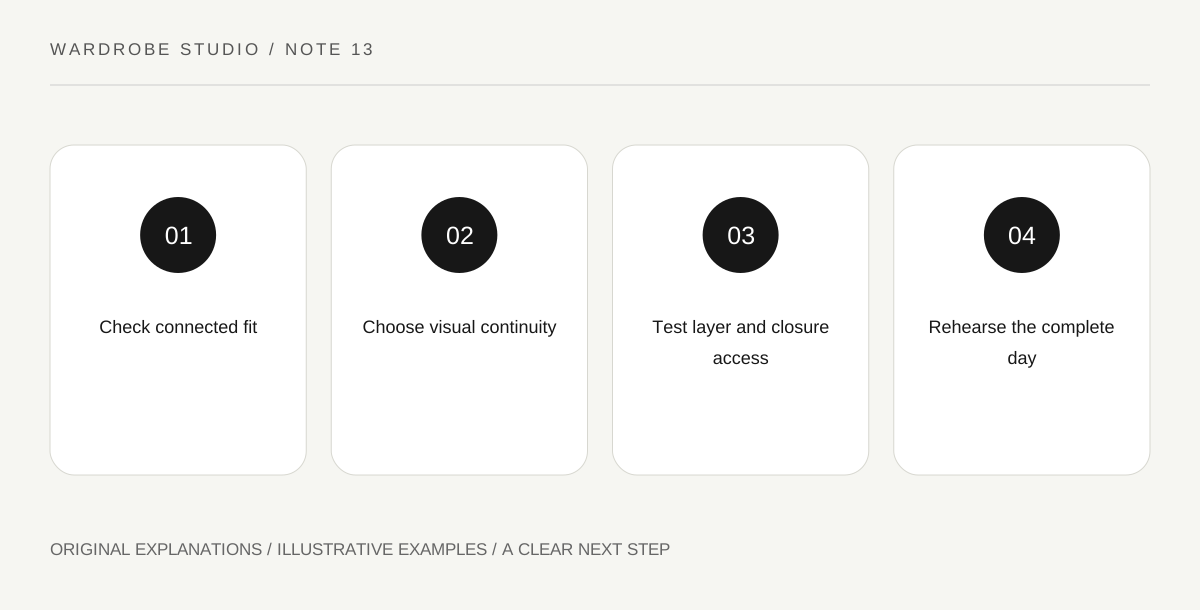
Original explanatory diagram. Read the full method and limitations below.
Check the connected length
A jumpsuit can fit comfortably at one area and still pull elsewhere because the upper and lower sections are joined. Notice the effect of sitting and raising your arms. Do not assume that a comfortable waistband alone establishes overall fit.
Try the garment with the underlayers you intend to wear. A change in layer thickness can affect the way the upper section sits. If the garment feels restrictive, consider another cut or suitable alteration advice rather than use posture or an accessory to hold it in a preferred position.
Decide whether to preserve the continuous shape
A plain jumpsuit may read as one field of colour, while pockets, seams and closures divide it into smaller areas. You can preserve that continuity with quiet companions or emphasize a feature already present. Neither approach is inherently more sophisticated.
Look at the garment from a normal distance. Which element attracts attention first: collar, zipper, pocket or fabric movement? Choose accessories after identifying that feature. A continuous garment does not require adding a new focal point merely because it has fewer separate pieces.
Add layers without blocking access
A jacket can frame the jumpsuit, but it may need to be removed to use a back closure. A complicated necklace or tightly arranged scarf can add further steps. Consider how the full combination works during the day, including where removed layers would go.
Practise managing the closure privately before committing to the outfit. If you need assistance and do not want to depend on it, choose another garment. This is a preference and access decision, not a failure to appreciate the jumpsuit’s design. Ease of use belongs in personal style.
Match the garment to the real setting
Construction, fabric, coverage and condition influence whether a jumpsuit fits an occasion. The category alone does not establish formal or casual status. Follow actual dress requirements and consider temperature and movement demands rather than assume one-piece dressing is automatically effortless.
Create a complete outfit with the real bag and outer layer, then perform a short routine of sitting, reaching and closure access. Note what requires adjustment. The outcome may be a streamlined solution or a decision to wear separates for that particular day; both are valid results of a useful check.
Illustrative one-piece trial
A wearer plans a long seated dinner in a jumpsuit with a back zipper. The standing fit looks good, but sitting pulls the shoulder area. A jacket also makes the zipper harder to reach. They choose another jumpsuit with more comfortable torso ease and a front closure, then keep accessories simple. The revised outfit addresses actual use rather than only the mirror image.
Practical checks
Optional checkboxes save only in this browser.
Questions that come up
Are jumpsuits always easier than separates?
Not for everyone or every day. They reduce the number of visible garments but can connect fit and access issues. Try the actual closure and movements before deciding whether the convenience suits you.
Should I add a belt to every plain jumpsuit?
No. A belt is an optional detail, and some garments already have a designed waist treatment. Decide whether you want to interrupt the continuous shape and whether the addition remains comfortable.
References and scope
These sources support the factual background. Examples and exercises are original illustrative teaching material. References do not imply endorsement.
- Getty Museum: Principles of design — Vocabulary for visual weight, emphasis, repetition, balance and proportion used in original outfit exercises.
- Getty Museum: Elements of art — Distinguishing line, shape, color value, intensity, space and texture.
- V&A: Secrets of Balenciaga’s construction — Examples showing that pattern cutting, fabric and construction determine garment form; not a prescription for modern outfits.
- V&A: Fashion collection — Fashion as a varied design discipline with multiple silhouettes and approaches.