Layer a knitted vest over a dress without trapping its movement
A knitted vest changes which parts of a dress remain visible and how its fabric moves. Treat the two garments as a system rather than assume they will layer comfortably because both fit separately. Check the armholes, waist area and surface friction before deciding whether the combination works.
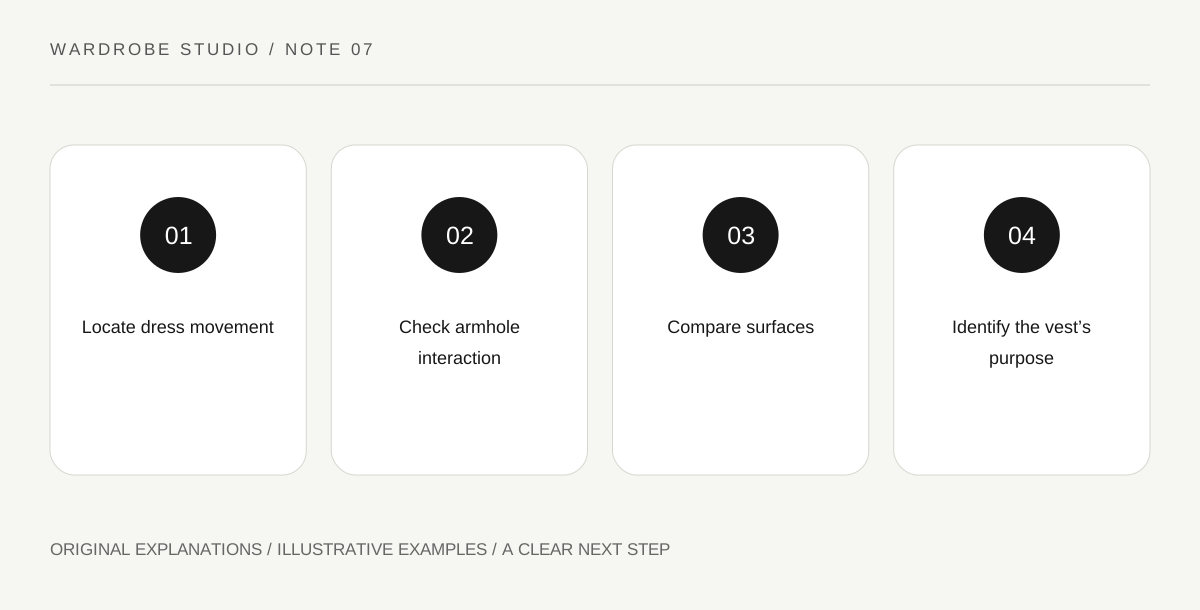
Original explanatory diagram. Read the full method and limitations below.
Locate the dress’s moving parts
A dress may have gathers, a loose bodice, sleeve volume or a defined waist seam. A vest can cover or compress those features. Identify what you want to keep visible and what you are comfortable changing, instead of expecting the dress to behave exactly as it does alone.
Try the dress first and note its ordinary movement. Then add the vest and compare. If the skirt no longer falls freely or the bodice bunches, locate the point where the layers interact. This helps distinguish a fabric-friction problem from a general dislike of the outfit.
Observe the dress neckline too: a vest can cover a key collar detail or pull it inward, changing the intended frame around the face.
Check armholes and sleeves together
A narrow vest armhole may trap a fuller sleeve or pull the dress upward. A larger opening can reveal more of the dress and feel easier, but might create a different shape than you expected. The opening needs to work with this sleeve rather than an abstract standard of fit.
Raise your arms, reach forward and sit. Notice whether the sleeve returns to its original position. If you must repeatedly pull fabric free, try another vest or dress. A combination that needs constant correction is not made practical simply by looking pleasing in a still image.
Compare knit texture with the dress surface
A pronounced cable or rib can become the main detail over a plain dress. A fine smooth knit leaves more attention for print or pleats below. These are visual possibilities, not requirements that texture must always be paired with plain fabric.
Touch and move the layers to see whether they catch. Fibre labels alone cannot predict every finished garment’s surface behavior. Avoid unsupported treatments to reduce friction; choose a more compatible pair or an appropriate underlayer while following the care instructions of the actual items.
Decide what the vest adds
The vest might provide warmth, change the visible shape or make a familiar dress feel different. Name its purpose. If it merely hides the detail you like and adds discomfort, you do not need to keep it because the combination appears in a style image.
Make one version with the vest and another using the dress alone with the same shoes and bag. Compare what is gained and lost. This is a specific layering decision, not a contest in which more pieces automatically mean more personal style.
Illustrative layering revision
A wearer puts a chunky vest over a printed dress with puffed sleeves. The sleeve fabric catches at the vest armholes. A smoother vest with larger openings lets the sleeves move and leaves the print visible around the shoulders. They choose it for warmth and texture, while keeping the chunky vest for a different base garment.
Practical checks
Optional checkboxes save only in this browser.
Questions that come up
Should the vest always end at the dress waist?
No. Different lengths create different visible divisions. Try the actual combination and check whether the dress’s gathers, seams and movement remain comfortable. There is no universal endpoint.
Can a chunky knit go over a patterned dress?
Yes, if you enjoy the combined activity and the layers function comfortably. Compare the texture and print together rather than apply a rule that one must always be plain.
References and scope
These sources support the factual background. Examples and exercises are original illustrative teaching material. References do not imply endorsement.
- Getty Museum: Principles of design — Vocabulary for visual weight, emphasis, repetition, balance and proportion used in original outfit exercises.
- Getty Museum: Elements of art — Distinguishing line, shape, color value, intensity, space and texture.
- V&A: Secrets of Balenciaga’s construction — Examples showing that pattern cutting, fabric and construction determine garment form; not a prescription for modern outfits.
- ACCC: Care labelling on clothing and textiles — Following care instructions for the finished garment rather than assuming treatment from appearance.