Use a shirt with a slip dress to change its geometry
A slip-style dress often has fluid lines and narrow straps. A shirt can introduce a collar, sleeves and a more defined edge, but it also changes movement and coverage. Explore the relationship without assuming the dress must be made more modest, formal or universally wearable.
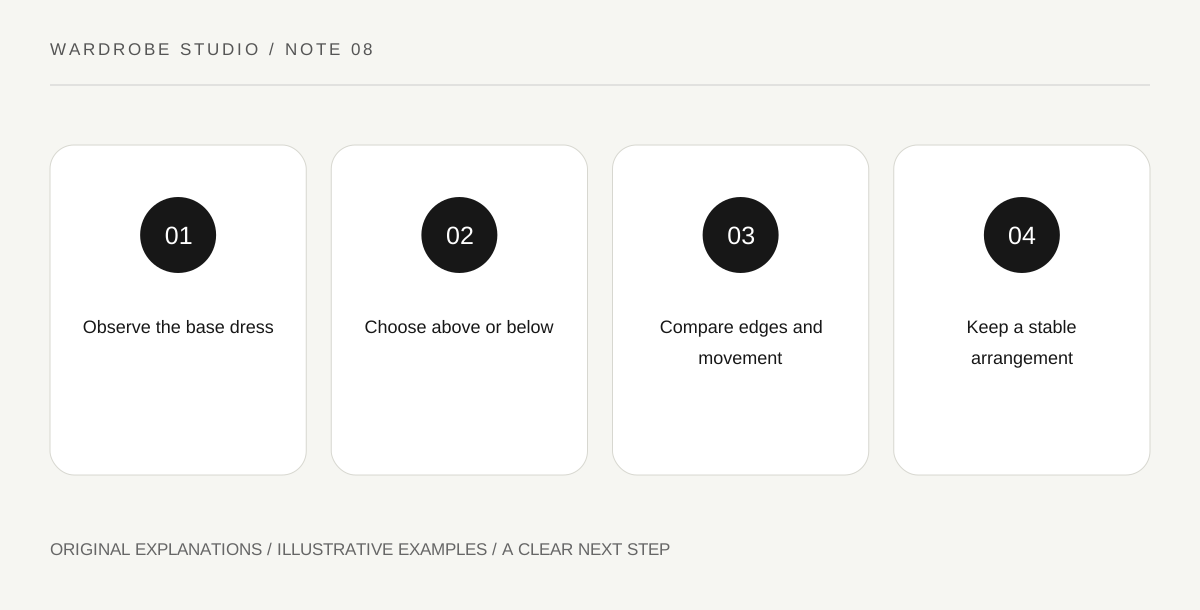
Original explanatory diagram. Read the full method and limitations below.
Start with the dress on its own terms
Observe how the dress falls, where its neckline sits and whether the fabric is matte or reflective. A bias-cut garment may move differently from one cut another way, but do not infer construction from a photograph alone. The actual garment’s behavior is the useful evidence.
Choose underlayers and coverage according to your comfort. A slip-style appearance does not establish opacity or fit. Check the dress in ordinary light and while seated before treating the shirt as a solution. The base garment should function for the way you plan to wear it.
Decide whether the shirt sits above or below
A shirt worn open above the dress frames the central area and adds a vertical edge. A shirt beneath changes the visible neckline and sleeves. These are different arrangements with different demands on space and friction, so try them separately rather than assume one shirt will suit both.
If layering underneath, check whether the dress has enough room for seams and sleeve fabric. If layering above, see whether the shirt catches at straps or repeatedly slides. The desired image should not require constriction or constant repositioning. A different shirt may solve the interaction more effectively than styling tricks.
Compare crisp and fluid edges
A crisp collar and straight shirt hem create a contrast with a fluid skirt. A soft shirt may continue the dress’s movement instead. Look at which edge becomes visible when walking and whether you want a strong frame or a gentle continuation.
Art and fashion references provide vocabulary for geometry, form and sheen, but they do not dictate your combination. Use those concepts to describe what you see. A precise observation such as the collar becomes the strongest angular detail is more useful than declaring that the outfit is simply balanced.
Choose a closing arrangement that stays comfortable
An open shirt, a normally fastened shirt or another intended wearing arrangement can change the visible shape. Avoid tying or fastening in a way that strains fabric or creates uncomfortable pressure. Follow the garment’s construction rather than force it into a position it will not maintain.
For a practical exercise, compare an open crisp shirt with an open soft shirt over the same dress. Keep other items constant and move normally. Note whether your preference concerns shape, temperature, coverage or feel. That distinction helps you choose the next combination without needing a new dress.
Illustrative fluid-and-crisp pairing
A wearer has a matte olive slip-style dress and two shirts. A stiff white shirt creates a strong angular frame but catches on the straps. A softer pale-blue shirt moves freely and gives the desired coverage. They choose the softer version for a day out, while saving the crisp shirt for an outfit in which its construction works comfortably.
Practical checks
Optional checkboxes save only in this browser.
Questions that come up
Must a slip dress be worn only in the evening?
No universal setting follows from the shape alone. Fabric, opacity, construction, companion pieces and actual dress requirements matter. Choose the specific garment for the occasion rather than rely on its category name.
Does a shirt automatically solve an uncomfortable neckline?
No. It may provide desired coverage, but it can also catch or shift. Check the complete arrangement in movement and choose another garment if the interaction remains uncomfortable.
References and scope
These sources support the factual background. Examples and exercises are original illustrative teaching material. References do not imply endorsement.
- Getty Museum: Principles of design — Vocabulary for visual weight, emphasis, repetition, balance and proportion used in original outfit exercises.
- Getty Museum: Elements of art — Distinguishing line, shape, color value, intensity, space and texture.
- V&A: Secrets of Balenciaga’s construction — Examples showing that pattern cutting, fabric and construction determine garment form; not a prescription for modern outfits.
- V&A: Art Deco fashion — Historical examples of geometry, fluid fabric, surface sheen and decorative detail.