Separate a coordinated set without losing what makes each piece useful
A matching set can work as a complete composition and as individual garments. Before separating it, identify the features that connect the pieces and the features each can carry alone. The aim is to discover practical combinations, rather than assume every top and bottom must produce the same number of outfits.
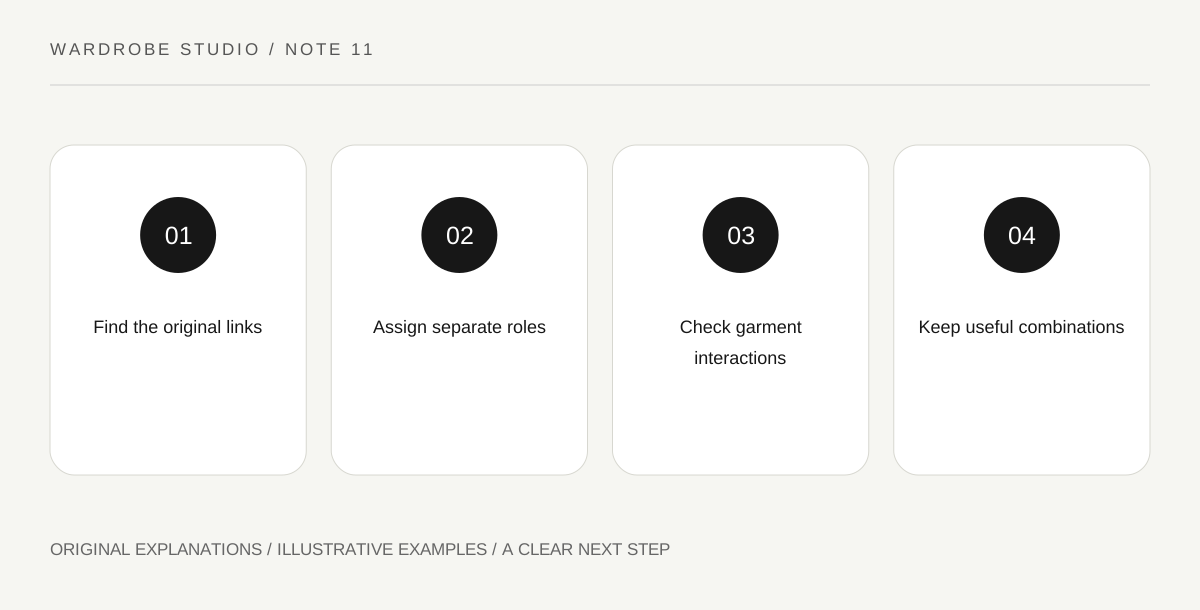
Original explanatory diagram. Read the full method and limitations below.
Identify the set’s connecting features
Matching fabric is the obvious link, but buttons, piping, print placement or repeated shapes may also connect the pieces. Look at the set together and describe what makes it read as one arrangement. This reveals which features remain when you remove half.
A top with a border designed to align with the trousers may look quite different on its own. That does not make separation wrong. It means the original relationship changes, and you should decide whether the new edge feels complete to you rather than pretend nothing has been lost.
Give each piece a separate role
Try the top with a familiar plain bottom and the bottom with a familiar plain top. Choose garments that already fit and feel comfortable so you can concentrate on the set piece. You are asking whether it can lead, support or add a particular detail in another outfit.
Keep a useful distinction between possible and desirable. Two items may technically be wearable together while offering a result you do not enjoy. An outfit count alone is not a measure of wardrobe value. A small number of combinations you willingly repeat can be more useful than a large theoretical grid.
Check construction and fabric relationships
A very fluid matching top may have relied on the lower half’s equally fluid movement. Paired with a stiff waistband, it may bunch or catch. Conversely, a structured set jacket may provide a clear frame for a different skirt. Observe actual interactions rather than assume colour compatibility is enough.
Check closures, pockets and any lining that becomes visible differently when the pieces separate. A set’s original photograph may hide these details. Try sitting and ordinary reaching, then decide whether the new companion supports the garment’s construction and your daily tasks.
Preserve the option of wearing the set together
If you value the complete set, consider how separate wear and care affect its appearance over time. Follow each item’s instructions and do not assume matching fabric can always receive identical treatment if construction differs. The practical goal is to keep both garments usable.
Make a small note of two separate outfits and the complete set, including what each is for. Do not require every new combination to look unrelated; shared personal preferences naturally recur. Separation is useful when it offers a real option, not when it becomes a challenge to disguise the set’s identity.
Illustrative printed set
A wearer owns a printed short-sleeved top and matching trousers with a border motif. The complete set feels graphic. The top works with a plain skirt because its border remains visible, while the trousers work with a simple knit that does not catch at the waist. They keep these two combinations and reject an awkward third without treating the lower outfit count as failure.
Practical checks
Optional checkboxes save only in this browser.
Questions that come up
Should every matching set be split into many outfits?
No. Some are most satisfying together, and that can still be useful. Explore separation if it serves your wardrobe, not because every purchase must meet a universal combination count.
Can matching pieces have different care needs?
Yes. Linings, trims and construction can change the finished item’s instructions. Read each label and avoid assuming that matching colour or fabric means identical treatment is appropriate.
References and scope
These sources support the factual background. Examples and exercises are original illustrative teaching material. References do not imply endorsement.
- Getty Museum: Principles of design — Vocabulary for visual weight, emphasis, repetition, balance and proportion used in original outfit exercises.
- Getty Museum: Elements of art — Distinguishing line, shape, color value, intensity, space and texture.
- V&A: Secrets of Balenciaga’s construction — Examples showing that pattern cutting, fabric and construction determine garment form; not a prescription for modern outfits.
- ACCC: Care labelling on clothing and textiles — Following care instructions for the finished garment rather than assuming treatment from appearance.