Wear a tunic over trousers by treating the two hems as a composition
A tunic-and-trouser combination creates several visible horizontal and vertical edges. Instead of applying a fixed ratio, look at where those edges land and whether the layers move independently. The aim is an outline you enjoy and enough ease for everyday tasks, with no requirement to disguise your shape.
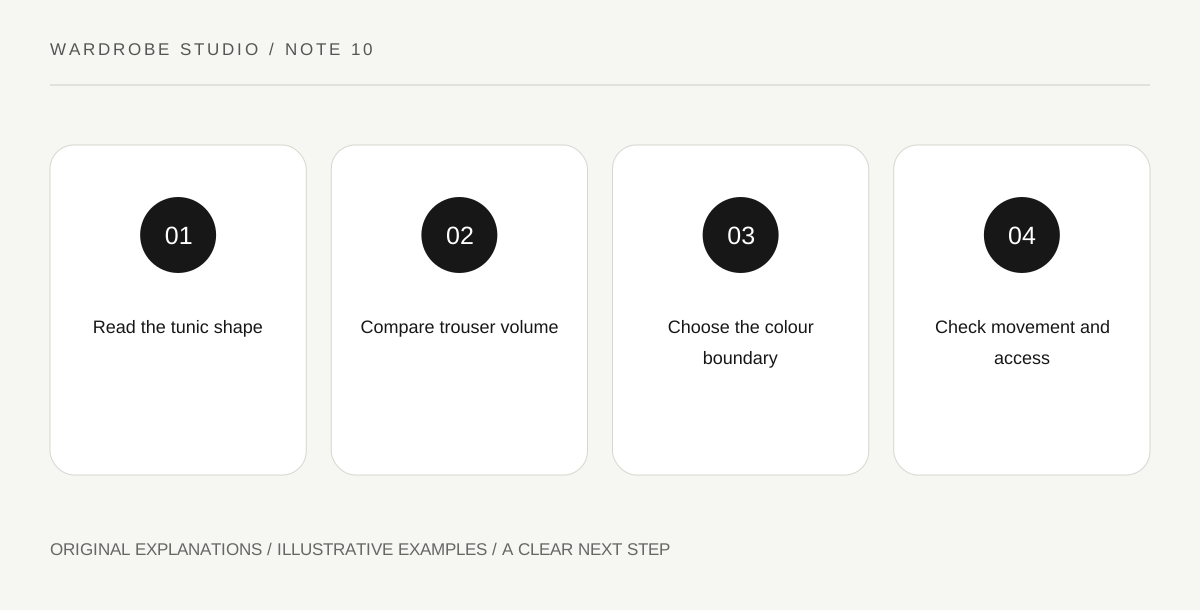
Original explanatory diagram. Read the full method and limitations below.
Identify the tunic’s openings and volume
A tunic may have straight sides, curved hems or side splits. Those features determine how it moves over trousers. Check whether the lower edge opens comfortably when you sit and whether a side split reveals the trouser line in a way you like.
Observe the garment from front and side. A long front with a shorter back behaves differently from an even hem. Naming the actual shape makes the styling question more precise than asking whether long tops are universally flattering. The answer depends on this garment and your preference.
Choose whether the trousers continue or contrast
Narrow trousers can let a loose tunic remain the main volume. Wider trousers can create a deliberately broad, flowing outline. Neither is compulsory. Try the actual fabrics: a stiff wide leg and a fluid wide leg may produce very different results beneath the same top.
Look at the space between the tunic’s sides and the trouser legs as you walk. The layers can separate, overlap or catch. A pleasing still outline may feel awkward if the fabrics repeatedly pull against one another. Function belongs in the composition decision.
Use colour boundaries intentionally
Similar values can make the garments read as a continuous field, while a strong light-dark difference makes the tunic’s hem more visible. You do not need exact matching colours for continuity. Compare how light or dark the pieces look together rather than rely only on names such as navy.
If you want a visible boundary, make it a chosen feature rather than something to apologize for. A contrasting lower layer can emphasize the tunic’s curved hem or split. There is no rule that an outfit must create the illusion of longer legs to be successful.
Check access and seated comfort
Try using trouser pockets and any tunic closures. A long top that blocks every pocket may still suit a day with a bag, but that should be a deliberate practical choice. Check whether the waistband remains comfortable under the additional fabric when seated.
Create two versions using the same tunic: one with a narrow trouser and one with a wider cut. Record the outline, movement and pocket access separately. The result can be two useful outfits for different activities, rather than one winning proportion that every future outfit must copy.
Illustrative tunic comparison
A wearer has a pale tunic with deep side splits. Dark narrow trousers make the curved hem clearly visible; wide pale trousers create a more continuous flowing shape. Both permit comfortable sitting, but the wide pair’s pockets are difficult to reach. The wearer chooses the narrow pair for errands and the wide pair for a social visit with a bag.
Practical checks
Optional checkboxes save only in this browser.
Questions that come up
Must a long tunic always have narrow trousers?
No. A wider lower half creates another valid outline. Compare fabric behavior, movement and your preference rather than assume only one proportion is acceptable.
Should I match both garments exactly?
Only if that is the effect you want. Similar value or texture can connect different shades, while contrast can make the tunic’s shape visible. The actual relationship matters more than exact labels.
References and scope
These sources support the factual background. Examples and exercises are original illustrative teaching material. References do not imply endorsement.
- Getty Museum: Principles of design — Vocabulary for visual weight, emphasis, repetition, balance and proportion used in original outfit exercises.
- Getty Museum: Elements of art — Distinguishing line, shape, color value, intensity, space and texture.
- V&A: Secrets of Balenciaga’s construction — Examples showing that pattern cutting, fabric and construction determine garment form; not a prescription for modern outfits.